
Moon Chart Tonight
Will the Moon be up tonight, and where should you look? Share your location or type your latitude and longitude, and this chart calculates tonight’s moonrise, moonset and the time the Moon is highest, shows how much of it is lit, and plots its height above the horizon through the night with compass directions — handy for stargazing, photography and night walks.
- Free to use
- No sign-up
- Runs in your browser
Tonight’s Moon
Night Sky Planner Pack
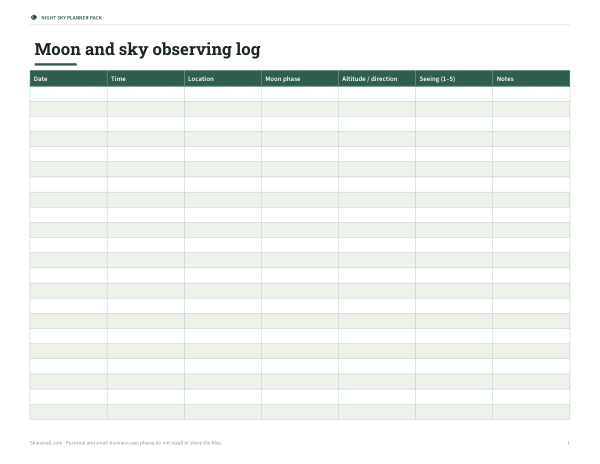
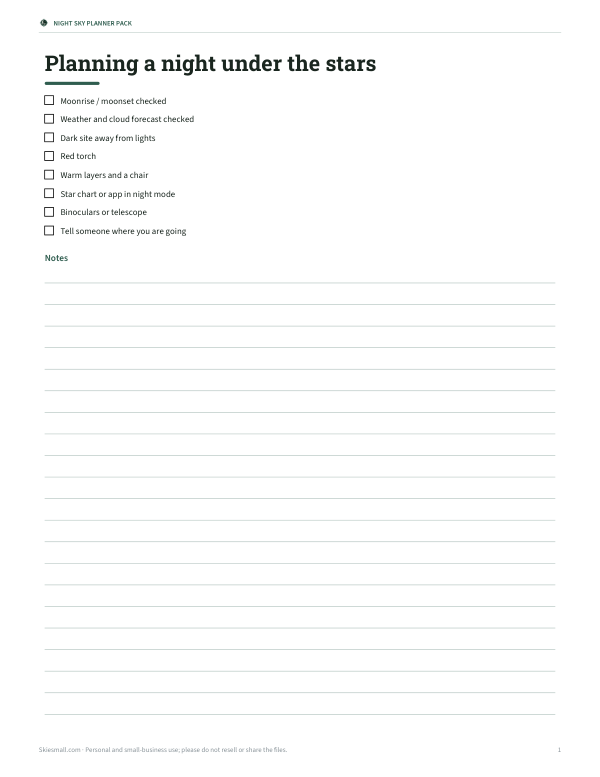
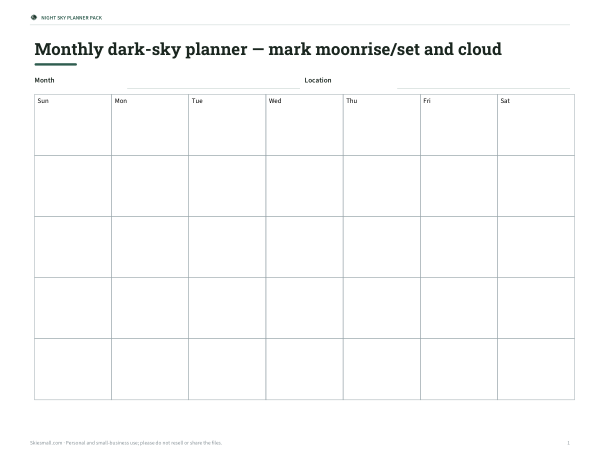
Printable moon observation log, a night sky planning checklist, a monthly moon and dark-sky calendar template, an astrophotography settings card and an Excel observing log.
- Observing log (XLSX)
- Planning checklist (PDF, DOCX)
- Dark-sky calendar (PDF)
- Photo settings card (PDF)
Formats: XLSX, PDF, DOCX. Instant download after payment (link valid 72 hours, up to 5 downloads). AI-assisted: the templates were drafted with AI help and reviewed and laid out before publishing.
$3.00 USD, one-time 4 files · about $0.75 each
- Instant download
- 7-day refund
- Secure checkout by Stripe
7-day money-back guarantee. Full refund within 7 days of purchase, even after you download.
Free sample: Dark Sky Calendar (PDF, 53 KB)
Full refund within 7 days — see the refund policy and license.
Free printables
Single sheets you can print right now, no sign-up. The full pack adds every sheet in one download plus the editable files.
 AWG Wire Gauge Chart (Printable PDF and Excel)
 Printable Moon Photo Settings Card
What the chart shows
For the date and place you choose, the chart calculates when the Moon rises above and sets below the horizon, when it is highest in the sky between noon and the next noon, how much of its disc is lit, and where it is right now — its altitude (angle above the horizon) and compass direction. The graph plots the Moon’s altitude through the night; the part above the horizon line is when you can see it.
Why moonrise changes every day
The Moon moves eastward around its orbit by about 13° a day, so Earth has to turn a little further each day before the Moon comes back into view. On average moonrise is about 50 minutes later each day, but the delay varies from under 30 minutes to over an hour depending on the season and your latitude. Around the autumn equinox, the full moon rises only a little later each evening for several nights — the “Harvest Moon” effect.
When is the Moon visible?
| Phase | Rises | Best seen |
|---|---|---|
| New moon | Around sunrise | Not visible |
| Waxing crescent | Morning | Early evening in the west |
| First quarter | Around noon | Afternoon and evening |
| Waxing gibbous | Afternoon | Most of the night |
| Full moon | Around sunset | All night |
| Waning gibbous | Evening | Late night and morning |
| Last quarter | Around midnight | After midnight and morning |
| Waning crescent | Before dawn | Pre-dawn in the east |
How it is calculated
The chart uses a compact version of the lunar theory published in astronomical almanacs: the Moon’s longitude and latitude are computed from its mean motion plus the largest periodic terms, converted to right ascension and declination, and combined with sidereal time for your longitude to give altitude and azimuth. Rise and set are the moments the Moon’s centre crosses a small positive altitude that allows for its size, atmospheric refraction and parallax. The result is typically within about 10 minutes of precise almanac times — ideal for planning.
Using the chart for stargazing and photography
- Dark skies — look for nights when the Moon sets early or rises late, not just new moon.
- Moonrise photos — a rising full moon near a landmark looks dramatic; note the compass direction of moonrise.
- Night walks — full and gibbous moons give useful natural light.
- Meteor showers — check whether a bright moon will be up during the peak hours.
- Telescope viewing — the Moon is steadiest and sharpest when it is high above the horizon.
Worked example
For New York (40.71° N, 74.01° W) the chart lists moonrise and moonset times for the chosen date, the time the Moon is highest tonight with its altitude, and the current direction — for example “35° altitude, SE”. If the graph shows the Moon below the horizon until after midnight, early evening is a good time for spotting faint stars and planets.
Moon altitude and azimuth explained
Altitude is the angle above the horizon: 0° is on the horizon and 90° is straight overhead. Azimuth is the compass direction, measured clockwise from north (90° east, 180° south, 270° west). The Moon rises roughly in the east and sets roughly in the west, but the exact direction changes through the month and with the seasons — sometimes rising well north of east and sometimes well south of it. That is why the chart gives compass directions.
Planning with the chart
- Check the phase: a bright moon washes out faint stars.
- Note moonrise and moonset to find the dark hours.
- Look at the altitude graph to see when the Moon is highest for photos or telescope views.
- Check the direction of moonrise if you want it rising behind a landmark.
- Combine with the weather forecast for cloud cover.
Moon and tides
The Moon’s gravity raises tides, but high tide does not happen exactly when the Moon is overhead — local coastlines and ocean basins delay it by hours. For tide times, use a local tide table; the Moon chart is for seeing the Moon itself.
Why the Moon looks bigger near the horizon
A rising moon often looks enormous, but it is not physically larger — it is actually a little further from you than when it is overhead. The “Moon illusion” is a trick of perception: the brain compares the Moon with trees and buildings on the horizon. A photo with a long lens shows the same size at the horizon and overhead.
Privacy
Your location is only used if you press “Use my location”, and all calculations happen in your browser. Nothing is stored or sent.
Frequently asked questions
What time does the Moon rise tonight?
Enter your location and the chart calculates moonrise in your device’s time zone.
Why is there no moonrise on some days?
Because moonrise shifts later each day, occasionally it falls after midnight into the next date.
Where should I look for the Moon?
The chart shows its current compass direction and altitude.
How accurate are the times?
Typically within about 10 minutes; hills and buildings affect what you see.
Is the Moon up during the day?
Often — around the quarter phases the Moon is visible in daylight.
Why does moonrise happen later each day?
The Moon moves along its orbit, so Earth must turn about 50 minutes longer on average before it rises again.
What is the Moon’s altitude?
Its angle above the horizon, from 0° at the horizon to 90° overhead.
Can I see the Moon from anywhere on Earth?
Yes, the same phase is seen everywhere, though rise and set times differ by location.
Why is the Moon sometimes visible in the morning?
After full moon it rises later each night and is still up after sunrise.
Is my location stored?
No, it is used only in your browser.